

The Object Comes First: A Miami Take on Collectible Design and How We Live
Most people buy a home, then fill it. The most interesting owners I know do the opposite.
We talk about space as if it comes first. Find the home, then fill it. Four bedrooms, good light, a view. The furniture arrives after, arranged to fit what the architect already decided.
A recent conversation in Miami's design world flipped that order for me entirely. Drawing from my travels, repositioning properties to be market ready, and years in the field, I’ve been turning this concept over in my head, finding new ways to apply it for my clients.
Some people do not choose a space to fit their life. They choose a space because something they already have, or are building toward having, demands a very specific kind of room. The object comes first. The architecture, location and price negotiate it afterwards. Sometimes it works and other times it backfires but then you re-evaluate what is priority - that is where I come in to ask the deeper questions.
This is the quiet logic behind collectible design many architects and interior designers face, and it is becoming one of the more interesting undercurrents in Miami real estate right now.
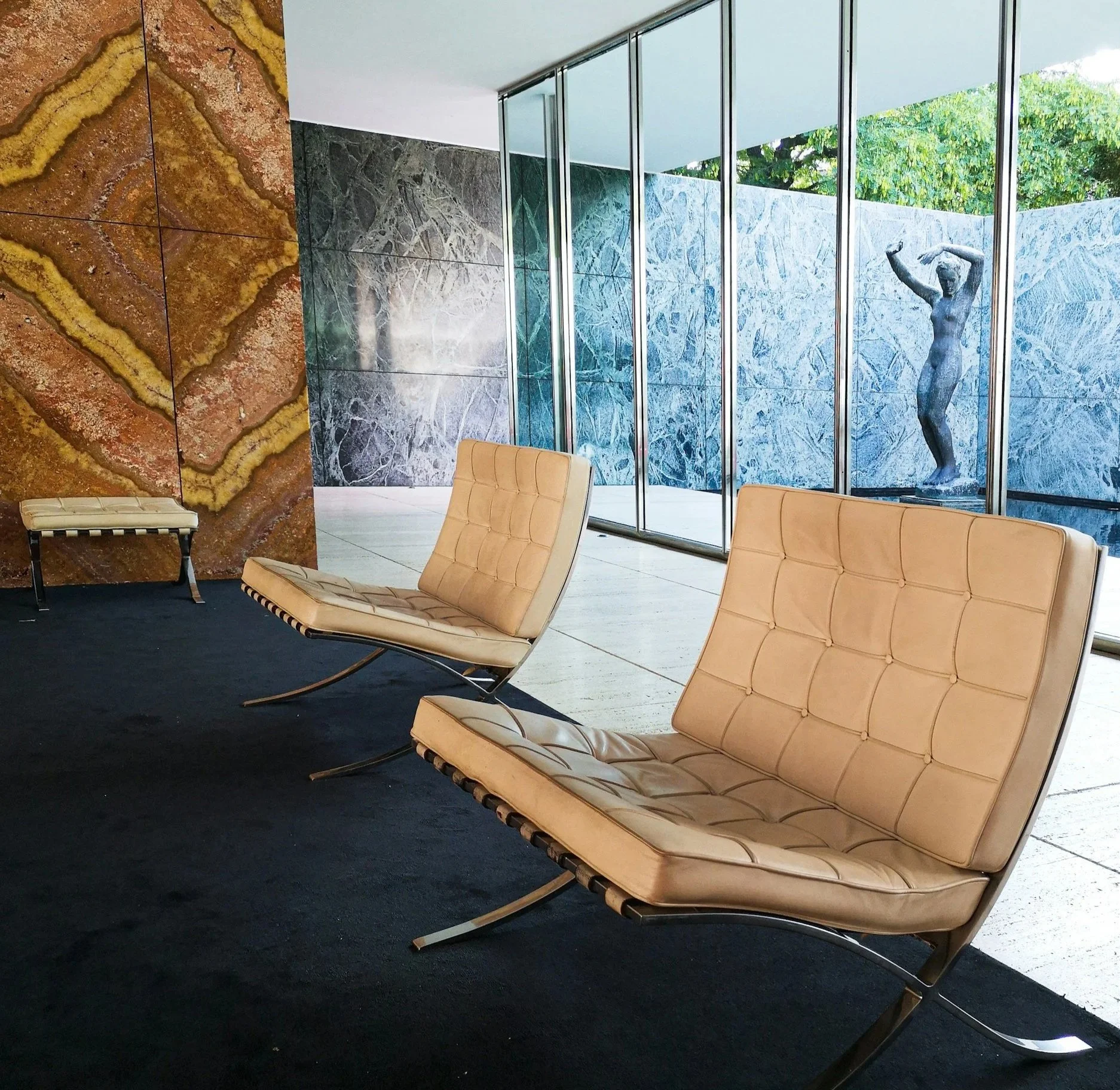
"Less Is More" in practice: the Barcelona Pavilion, one of the most significant works in modern architecture, recreated in the 1980s based on the 1929 original in Spain. Curated pieces give it a museum feeling, natural stone walls, onxy and marble, in darker tones enhancing the Barcelona chairs and footstool. Pictured here are the originals, designed by Mies van der Rohe and Lilly Reich.
What Collectible Design Actually Looks Like In a Home
It sounds abstract until you picture it, and then it is immediately familiar.
A serious wine collection does not want a spare corner. It wants climate control, humidity stability, and a room engineered around preservation, not aesthetics.
A grand piano is not furniture. It is a physical argument about where every other object in the room is allowed to sit, because sound moves through space and bad placement ruins it.
A single significant piece of collectible design, the kind that shows up in a gallery's Special Projects section, does not get accessorized around. The room gets built to hold it, light it, and let it breathe, the way the famous chairs above were never meant to sit in a corner.
None of this is about wealth for its own sake. It is about a different relationship to ownership. The object is not decorating the space. The object is dictating the space's terms.
Why Collectible Design Matters for Miami Real Estate Now
Design Miami returns this December 1 - 6, 2026 folded into Miami Art Week, a favorite of mine and thousands too. It is a fair that started in 2005, where galleries from around the world bring furniture, lighting, and objects that are less about function and more about telling a story, the creator, the material and design, how many exist, who has not owned it yet, but will. That's what collectible design actually is: not just well-made furniture, but pieces valued the way art is valued, for who made them and how rare they are, not just how they look or work. It's grown into the place people go to see where that world is actually heading. This year's theme is "Unveiling," which is really just an invitation to stop looking at the surface of an object and start asking about what's behind it. Who made it. Why. What it took to make, not unlike what I've spent years asking about doors themselves, the whole reason "Doors" is in my name.
I've noticed the same shift happening in real estate. It matters for any seller with something like this in their home, not just people bidding at a fair. If what you own has weight, provenance, a story, a demand, then the standard question, "how many bedrooms does this have," is the wrong one entirely.
The right question is: what does a piece, an art object, a $30,000 custom Italian dining table, need from a room, and does the room actually give it that, and will a buyer see that too? That's what I bring to a listing when hire me to represent your property to sell - one advisor with a behind the scenes team seeing both sides of it, not two people seeing half of it each.
A Different Way to Walk Through a Home
For some time, I have started looking at spaces differently because of this. Not "does this room look good," but "what is this room capable of holding? How is it structurally and spatially, beyond what's already in it."
A specific wall could support real weight. A corner with the right light and nothing competing with it. A room that could be sealed off, climate-controlled, protected. Or one built for a specific purpose entirely, the kind of room that says: aging parents, someday with their most treasured items they hold on to.
This is not staging in the traditional sense. It is not about making a house look move-in ready for the widest pool of possible buyers. It is about recognizing that some spaces are quietly built to serve something specific, and some buyers are looking for exactly that, even if they have never said it out loud. It is the same eye I bring to every Doors Staging & Design project, just aimed at a different kind of client.
If you have ever stood in a room and thought this could hold something important, you already understand the idea. You just did not have a name for it.
You do now. That's the conversation I like having. I'd like to hear what yours is holding. Open that door here.